
Rinan’s Tech provides managed cybersecurity services to businesses across Melbourne and Australia. We protect your systems, your staff and your data from ransomware, phishing, malware and unauthorised access, and we show you exactly where you stand against the Essential Eight.
Here’s Why You Should Choose Our Cyber Security Services:

There is a persistent belief among smaller businesses that they are too small to be worth attacking. The opposite is closer to the truth. Most attacks are not targeted at all. They are automated, scanning for whatever is unpatched, unprotected, or reusing a password from an old breach.
A twelve person accounting practice and a six hundred person manufacturer get scanned by the same tools. The difference is that the larger business usually has someone watching.
The cost of getting it wrong is rarely just the ransom. It is the days of downtime, the clients you have to notify, the insurance excess, and the awkward conversations with people who trusted you with their information.

Advanced filtering that stops most attacks before they reach an inbox, plus protection against impersonation and business email compromise. Correctly configured SPF, DKIM and DMARC records so nobody can convincingly send email as your business.

Every laptop, desktop and server monitored for ransomware, malware and suspicious behaviour, with threats isolated automatically. Operating systems and applications kept patched, because most successful breaches exploit a vulnerability that already had a fix available

Multi factor authentication rolled out across your business, with permissions set so that a single stolen password is not enough to get in. Access reviewed as people join, change roles and leave.

Unusual activity flagged and investigated around the clock, not only during business hours. Security works alongside your backups, with recovery tested rather than assumed, so that a bad day stays a bad day rather than becoming a bad quarter.
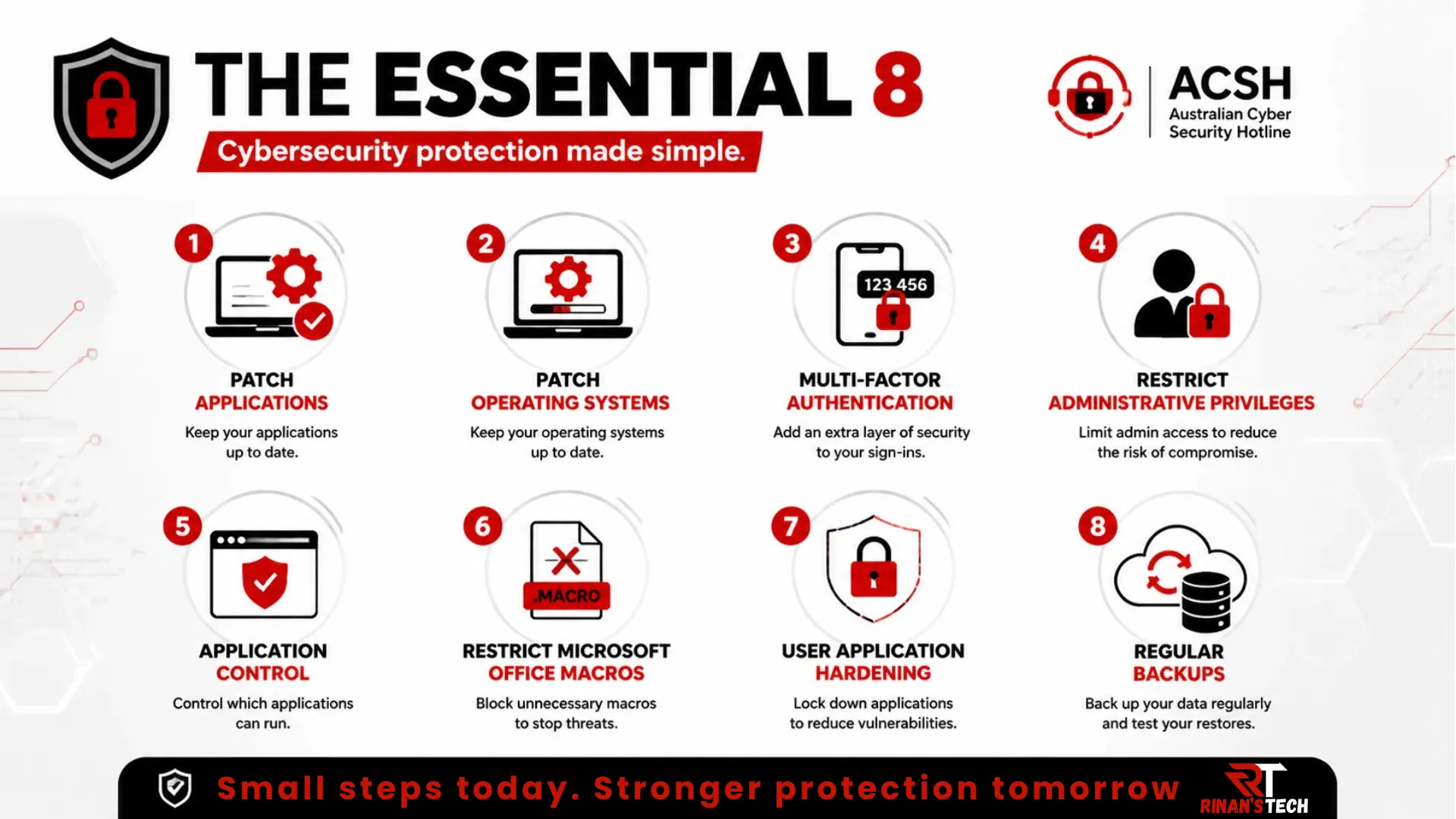
The Essential Eight is a set of eight baseline mitigation strategies published by the Australian Cyber Security Centre. It covers application control, patching applications, configuring macro settings, application hardening, restricting administrative privileges, patching operating systems, multi factor authentication and regular backups.
It is mandatory for many government linked organisations, and it is increasingly what insurers and larger clients ask about before they commit. An Essential Eight assessment maps your current environment against each of the eight controls and tells you honestly where you sit, and what it would take to lift your maturity.

No two businesses start from the same place. Here is how we work out where you are and what to do about it.


Review and strengthen the security of your cloud environments to ensure data protection, access control, and compliance with best practices.

Identify security gaps across systems, applications, and networks to reduce risk and prioritise remediation before vulnerabilities are exploited.

Detect and respond to suspicious activity in real time with intrusion detection solutions designed to identify threats before they cause damage.

Educate users on cyber security best practices, helping them recognise threats such as phishing and reduce human-related security risks.

Develop clear, tailored security policies that define acceptable use, access controls, and security responsibilities across your organisation.

Establish a clear, actionable plan to respond to cyber incidents quickly, minimise impact, and recover operations with confidence.
(0469) 390-579
No. Most attacks are not aimed at a specific business. They are automated scans looking for any system that is unpatched, unprotected, or using a password exposed in a previous breach. Small businesses are often easier to compromise because nobody is watching, which makes them attractive rather than uninteresting.
You need an assessment rather than an assumption. A security assessment reviews your accounts, devices, email configuration, patching status and backups, then reports where you are exposed. Most businesses we assess are surprised by at least one finding, commonly an old account still active or backups that have never been tested.
We review your systems, user accounts and access permissions, email security settings, device protection, patching status and backup arrangements. You receive a plain English summary of the risks we found, ranked by severity, with a recommended order to address them.
Cybersecurity is usually priced per user or per device each month, so costs stay predictable as your team changes. What you pay depends on how many people you have, what systems you run, and how much cover you need.
Possibly. Under the Notifiable Data Breaches scheme in the Privacy Act 1988, organisations covered by the Act must notify affected individuals and the Office of the Australian Information Commissioner about eligible breaches likely to cause serious harm. Coverage depends on factors including turnover and industry, and health service providers are covered regardless of size. This is general information rather than legal advice. We can help you understand your technical position and work alongside your legal adviser.
It helps considerably. Insurers now ask detailed questions about multi factor authentication, backups, patching and staff training before quoting, and some decline cover without them. Having these controls in place and documented makes applications and renewals much smoother.
We move to contain it first, isolating affected devices and cutting off the attacker's access, then restore from clean, tested backups. You get a clear account of what happened and what we are changing so it does not happen again. No provider can promise you will never be breached. What matters is how quickly it is contained and how completely you recover.
Yes. We regularly take on security and backups while day to day support stays with an existing provider or an internal IT person. We coordinate with them directly so nothing falls between the two of us.